What is MiroFish homes
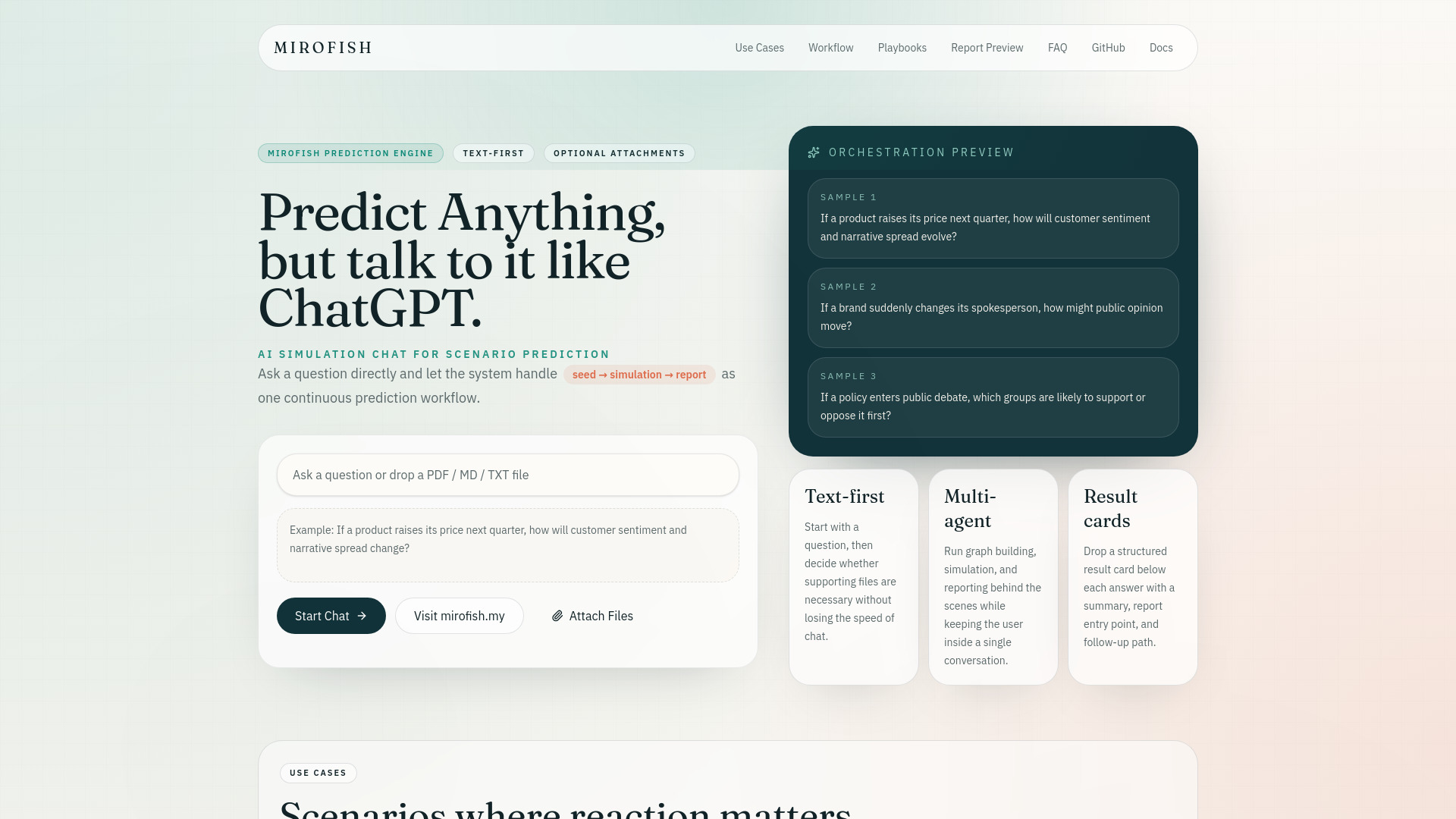
MiroFish is an AI simulation chat platform for scenario prediction and reaction modeling. It transforms text, PDF, Markdown, and TXT files into a structured workflow that includes knowledge graph building, multi-agent simulation, report generation, and follow-up chat. The system allows users to ask a question and receive a prediction report based on simulated audience reactions, narrative paths, and risk signals.
How to use MiroFish homes
- Start with a question: Enter a plain-language question about a scenario you want to predict (e.g., "If a product raises its price next quarter, how will customer sentiment and narrative spread change?").
- Optionally attach files: Upload PDF, Markdown, or TXT files to ground the simulation in specific reports, briefs, or source documents.
- Run the simulation: The system automatically builds a knowledge graph, runs agent simulations across multiple rounds, and generates a prediction report.
- Review the report: The report includes an executive summary, risk signals, narrative paths, and follow-up questions.
- Continue questioning: Ask further questions against the generated world to explore alternative scenarios or dig deeper.
Features of MiroFish homes
- Text-first prompts: Start with a question; files are optional.
- Multi-agent simulation: Runs graph building, simulation, and reporting behind the scenes within a single conversation.
- Result cards: Each answer includes a structured card with summary, report entry point, and follow-up path.
- Knowledge graph extraction: Automatically extracts actors, relationships, pressures, and factual anchors from input.
- Agent simulation: Personas interact across short-form and threaded social surfaces over multiple rounds.
- Prediction report: Condenses emergent behavior into turning points, risks, confidence signals, and follow-up paths.
- Deep interaction: Continue asking questions against the generated world instead of stopping at a static answer.
Use Cases of MiroFish homes
- Campaign Test: Pressure-test a launch narrative before it goes public by simulating how audience groups might amplify, resist, or reinterpret a campaign message.
- Pricing Reaction: Model customer sentiment, value perception, and likely objection paths across different segments before a price change is announced.
- Policy Stress Test: Use simulation as a tabletop exercise for controversy, coalition formation, and second-order reactions in a policy rollout.
- Market Narrative: Stress-test market stories where spreadsheets miss the feedback loop between analysts, retail attention, and public discourse.
Pricing
MiroFish is free to use (price: $0 USD).
FAQ
What kind of scenario is a good fit?
Use cases with human reaction loops: launches, pricing changes, policy debates, market narratives, crisis response, and creative continuation.
Do I need to upload files?
No. You can start with text, then add files when you want the simulation grounded in a specific report, brief, or source document.
What does the report include?
A useful report summarizes the likely trajectory, key actors, risk signals, evidence lines, and next questions to ask.
Is this a guaranteed forecast?
No. Treat it as exploratory decision support: a way to rehearse plausible reactions before using judgment, analytics, and real-world validation.