
What is NeuralTrust
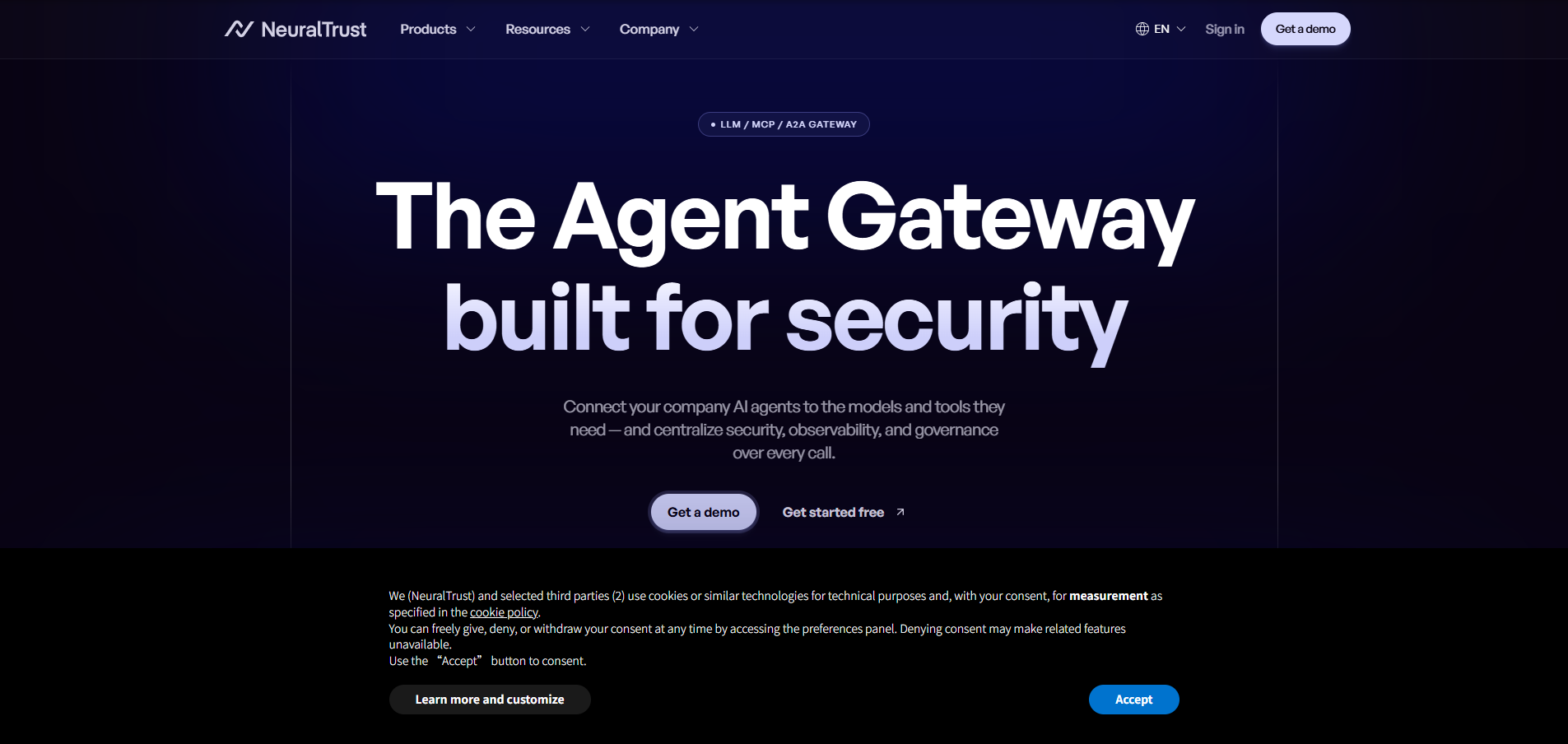
NeuralTrust provides TrustGate, an open source AI gateway designed for enterprises running LLMs and AI agents at scale. It sits in front of AI traffic to control access, enforce policies, and block threats like prompt injection and jailbreak attempts before they reach production. TrustGate ships with over 200 MCP connectors, enabling teams to plug in agents and tools without custom integrations.
How to use NeuralTrust
- Deploy TrustGate – Choose from SaaS (managed, ISO27001 certified, up in under an hour), Hybrid Cloud (SaaS control plane with private data plane, HIPAA and GDPR ready), or On-premises/air-gapped (full isolation, Kubernetes/Helm chart).
- Connect AI traffic – Route agent calls through TrustGate to any LLM provider (OpenAI, Anthropic, Azure, self-hosted) or MCP/A2A endpoints.
- Configure policies – Set organization-wide security rules, per-agent and per-tool RBAC, and end-user identity forwarding.
- Monitor and govern – Use the control plane for observability, audit trails, and threat detection.
Features of NeuralTrust
- AI Gateway – Model routing across OpenAI, Anthropic, Azure, and self-hosted models.
- MCP Gateway – Scoped tool access per user with full call records.
- A2A Gateway – Traced agent-to-agent delegation.
- Per-agent and per-tool RBAC – Fine-grained access control.
- End-user identity forwarding – Identity preserved through every hop.
- Cryptographic audit trails – Tamper-proof logs for compliance.
- Inline prompt inspection and PII redaction – Real-time security checks.
- Semantic caching – Reduce latency and cost.
- Deployment flexibility – SaaS, hybrid cloud, on-premises, air-gapped.
- Open source core – Self-hostable via a single install command.
Use Cases of NeuralTrust
- Enterprise AI security – Centralize security, observability, and governance over all agent calls.
- Compliance – Meet HIPAA, GDPR, FedRAMP, and IL4 requirements with audit trails and data isolation.
- Multi-model routing – Route requests across different LLM providers based on cost, latency, or policy.
- Agent tool integration – Connect agents to over 200 MCP-compatible tools without custom code.
- Threat prevention – Block prompt injection, jailbreak attempts, and other attacks before they reach production.
Pricing
TrustGate offers custom enterprise pricing. Contact sales for details. The open source core is free to self-host.
FAQ
What is an Agent Gateway and why do I need one? Without a gateway, every employee secures and controls their own AI traffic independently — or no one does. An Agent Gateway centralizes security, observability, and governance over every agent call in a single control point, eliminating security gaps, observability blind spots, and missing audit trails.
What protocols does TrustGate support? TrustGate supports three gateway types: AI Gateway for routing agent calls across any LLM provider (OpenAI, Anthropic, Azure, self-hosted), MCP Gateway for giving employees scoped tool access with a full call record, and A2A Gateway for traced agent-to-agent delegation as workflows grow.
Is TrustGate open source? Yes. TrustGate has an open source core available on GitHub. You can run it locally or self-hosted in your own cloud in minutes using a single install command, then upgrade to the enterprise version for advanced governance, compliance, and multi-team control.
How does TrustGate handle agent identity? TrustGate forwards end-user identity through every hop, enforces per-agent and per-tool RBAC, and maintains cryptographic audit trails that survive review by your security team and auditors.
What deployment options does TrustGate support? TrustGate supports SaaS (managed infrastructure, ISO27001 certified, up in under an hour), Hybrid Cloud (SaaS control plane with a privately hosted data plane, HIPAA and GDPR ready), and On-premises or air-gapped (full isolation for defence, government and financial sector, FedRAMP and IL4 pathway, deployed via Kubernetes and Helm chart).