
What is ToAPIs
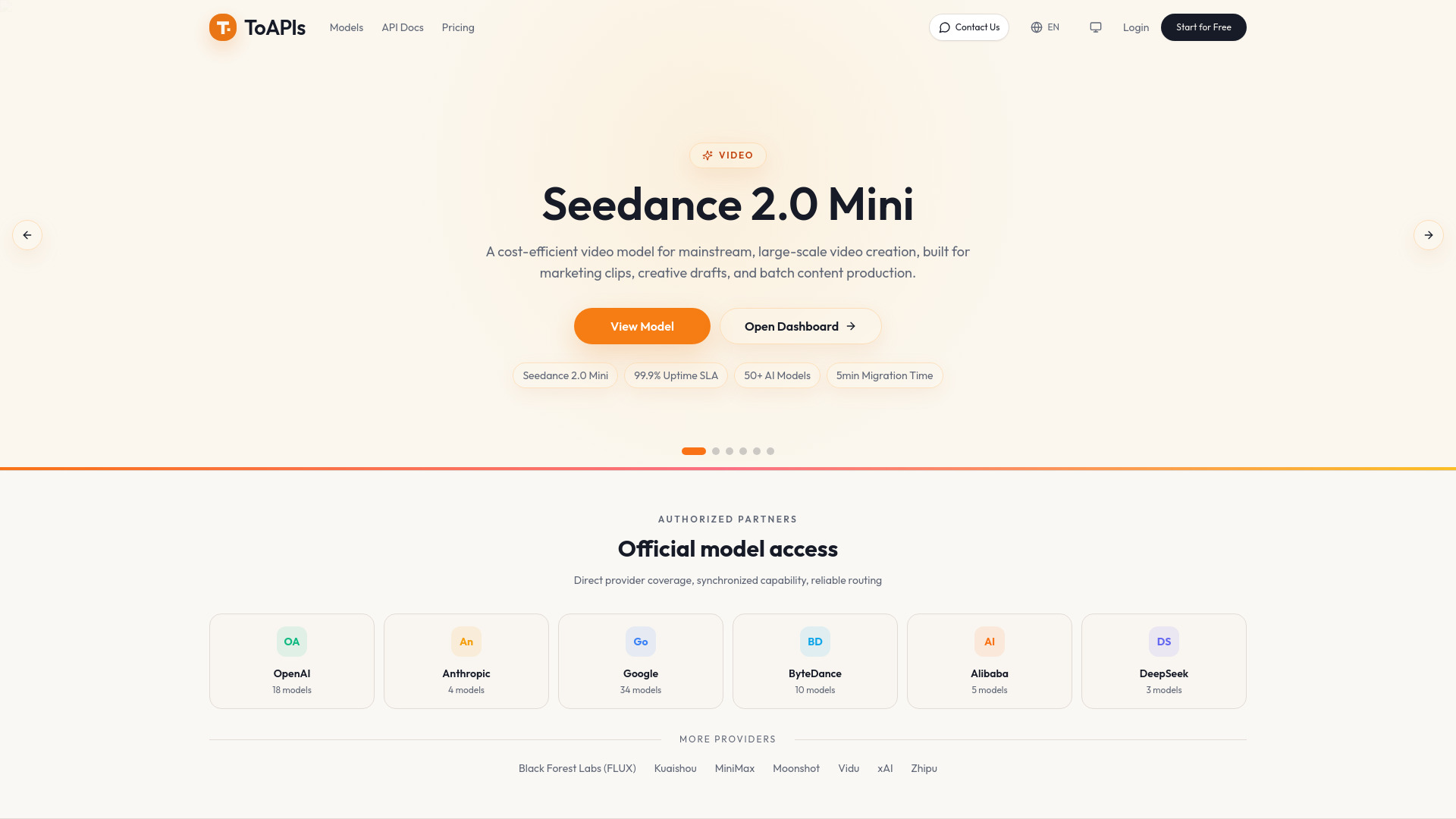
ToAPIs is an OpenAI-compatible AI API Gateway that provides unified access to 50+ AI models from multiple providers, including GPT, Claude, Gemini, DeepSeek, and more. It supports text, image, and video generation through a single API endpoint, offering savings of up to 70% compared to official rates.
How to use ToAPIs
- Replace Base URL: Change your API endpoint to
https://toapis.com/v1. - Create API Key: Generate a key in the console and configure permissions.
- Keep SDK: Continue using the OpenAI SDK or any HTTP client with the new base URL and API key.
Features of ToAPIs
- Unified API: Single OpenAI-compatible interface for 50+ models.
- Multi-Model Routing: Route requests to different models based on task, cost, or availability.
- Automatic Failover: Switch to backup models when primary providers experience issues.
- Cost Optimization: Route low-priority tasks to cheaper models.
- 99.9% SLA: High availability with health checks and redundancy.
- 5-Minute Migration: Minimal code changes required to switch from OpenAI SDK.
Use Cases of ToAPIs
- Content Production: Generate video scripts, cover images, ad creatives, and social media content.
- E-commerce Visual Marketing: Create product scenes, model try-on images, and promotional posters.
- Smart Customer Service: Automatically assign models based on query complexity.
- Code Assistance: Unified access to Claude, GPT, DeepSeek for different tech stacks.
- Financial Report Generation: Analyze earnings reports and generate structured summaries.
- Education Personalized Tutoring: Dynamically select models based on student level.
Pricing
ToAPIs uses pay-as-you-go pricing. Models are billed per token (input/output) or per request. Pricing is transparent and can be viewed on the pricing page. Low-priority tasks can be routed to cheaper models to control costs.
FAQ
How to migrate from OpenAI SDK to ToAPIs?
Simply change the base URL to https://toapis.com/v1 and replace the API key. Most scenarios require no SDK rewrite.
How does the aggregation platform reduce failure rates? Through multi-provider routing, health checks, and automatic failover, availability is maintained during single provider fluctuations.
How to optimize costs? Route high-priority tasks to high-quality models and low-priority tasks to cheaper models. Monitor quotas and retry costs.
When to use text-to-image vs image-to-image? Use text-to-image when no reference material exists; use image-to-image when you have an existing composition or style to maintain consistency.
How to handle rate limit errors (429)? Use exponential backoff with jitter, reduce concurrency, and switch to alternative model groups if necessary.